Speed Read
- Every company—not just tech—is sitting on invaluable IP and institutional knowledge (patents, archives, manuals, trial data, claims histories) that AI can now harvest and monetize in weeks instead of years.
- That is the “Big I” Todd Hewlin and Scott Snyder describe in Goliath’s Revenge: incumbents hold crown-jewel assets startups cannot buy, but most companies are spending their AI budget on “little i” (copilots, chatbots) instead of activating what they already own.
- Early movers are already booking the revenue. Wiley’s AI licensing hit $49 million and its net income rose 163 percent on essentially flat revenue.
- The alternative is the graveyard: average S&P 500 tenure has collapsed from 33 years to 24, heading to 12 by 2027, and only 52 of the original 1955 Fortune 500 companies are still on the list. Blockbuster’s fate, not Netflix’s.
- Harvesting dormant assets and monetizing them with AI is becoming the new normal, not a science project, and it follows a five-step process: Inventory, Provenance, Ontology, Agency, Market. Skip a rung and the program fails.
The assignment: go to the attic and change your future!
Finding Rembrants
In 1999 Kevin Rivette and David Kline published a book with a title that did most of the work: Rembrandts in the Attic. Their argument was that corporations were sitting on patent portfolios worth fortunes and treating them like old furniture. The proof point was IBM, which started licensing its unused patents in 1990 and watched royalties climb from about $30 million a year to more than $1 billion by the end of the decade. Same patents. Same attic. Somebody finally climbed the ladder with a flashlight.
Twenty-seven years later the attic is bigger, the flashlight is brighter and the Rembrandts have changed shape. They are film reels in a climate-controlled vault in Burbank CA or old insurance files housed in Secaucus NJ. Forty years of service manuals and technician notes at an equipment maker. The failed Phase 3 trial that produced six million data points and one sad press release. Call recordings, underwriting files, CAD drawings, editorial morgues and master tapes nobody has touched since the Clinton administration.
The thesis of this piece is simple. AI has collapsed the cost of turning a dormant asset into a product. What used to require a restoration studio, a translation bureau, a data science team and eighteen months now requires a rights review, a knowledge model and a few weeks. Companies that treat this as a monetization program rather than a science project are already reporting the revenue. Everyone else is paying to store the boxes which Iron Mountain is grateful for.
Go to the attic. That is the whole assignment. The rest of this piece is about what you will find there and what to do with it.
What actually changed
Three things, and they compound.
First, extraction got cheap. Film restoration that once ran to hundreds of thousands of dollars per title and eighteen months of frame-by-frame labor now runs in days at a fraction of the cost, with studios reporting cost reductions of up to 90 percent. Dubbing that once meant a booth, a cast and a per-language budget now means a licensed voice model and a director reviewing the output. Structuring a million pages of PDFs is a weekend for an agent, not a quarter for a team.
Second, the buyers showed up. Wiley reported $49 million in AI licensing revenue for its fiscal year ended April 30, 2026, up from $40 million the prior year, and its net income rose 163 percent on essentially flat revenue. Read that again. The revenue line did not move. The profit line nearly tripled, and the difference was the attic. Wiley now serves seven of the top ten pharmaceutical companies with inference-based content subscriptions.
Third, the rules got written. The music industry spent 2024 suing AI companies and spent 2025 and 2026 licensing to them. Reuters, Getty and every major label now have signed terms. The market is no longer hypothetical. It has term sheets.
Bada Bingo!
The Goliath problem
In another one of my favorite business books, Todd Hewlin and Scott Snyder wrote Goliath’s Revenge in 2019 to make a point that was unfashionable at the time: incumbents have advantages startups cannot buy. They called them crown jewels. Installed base. Brand reach. Existing customer relationships. Data sets. Blocking patents. The book’s second rule was to pursue both Big I and little I innovation, and its third was to treat your data as currency and build a data balance sheet for it.
Here is the uncomfortable diagnosis. Most large enterprises today are spending their AI budget entirely on little i. Copilots in the inbox. Summaries of meetings. A chatbot on the support page. These are fine and they are also table stakes, which means they earn you the right to stay in business and nothing more. Big I innovation, the kind that creates the next version of your company, is sitting in storage waiting for someone to notice it is an asset.
Blockbuster had a customer database of 65 million households, a physical footprint in every American suburb and a brand that was a verb. Be Kind, Rewind – Remember that? It also had the Netflix acquisition on the table for $50 million and passed. Netflix, meanwhile, has reinvented its entire business model three times: DVDs by mail, then streaming licensed content, then original production. Each reinvention started with something it already had (a subscriber base, a recommendation engine, a viewing history) and built the next business on top of it. That is the pattern. Not a pivot. A stairway. Each step funded by the one taken before.
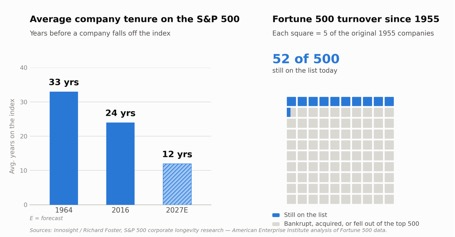
Two ways to see the stakes: the clock companies have to reinvent on is shrinking, and most don’t make it.
The question for your board is not “should we do AI.” It is “what do we already own that becomes ten times more valuable when it can be read, reasoned over and sold by a machine.”
That is a Big I question, and the answer is usually in the attic.
Three attics, three business models
The examples matter more than the theory, so here is the walk-through. But an attic is not one room. It is at least three, and each one monetizes differently, carries a different risk and needs a different rung of the ladder first.
Room one: creative and media archives
Film, music, publishing, news, images and cultural collections. The asset is finished work, the buyer is external and already writing checks, and the entire game is rights and tiering.
The studio vault is the original Rembrandt. Warner Bros., Universal and Paramount are re-monetizing catalog titles that sat dormant for decades because they were too expensive to restore and too degraded to license at premium rates. AI upscaling, grain reduction and frame reconstruction changed the math. Layer on localization and a title that was only ever dubbed into four languages can now be dubbed into thirty, with lip-sync, in the original actor’s cloned voice where rights allow. One back-catalog film becomes thirty products from mini reels to Japanese versions of the Honeymooners. The vault is not an archive. It is a release slate that never ends.
Music shows what happens when the pieces get priced. The catalog was always the asset; what changed is that it can now be licensed in units the industry never had a rate card for: stems, timbre, likeness. Universal’s settlement with Udio created a walled-garden platform where fans generate music from licensed catalog, cannot export it and pay per output. Warner settled with Suno and Udio. Klay got all three majors. Every deal is opt-in, and the NO FAKES Act cleared the Senate Judiciary Committee unanimously in June, which means voice and likeness are about to become a federal property right. If you own a catalog and have not modeled who consented to what, you are about to find out how expensive that is.
Publishing shows which product to bet on. Wiley’s training-data checks got the headlines, but training revenue is lumpy and will shrink as models saturate. The durable business is inference: recurring subscriptions where a pharma company pays to query the content rather than copy it. Content as a service has a fundamentally different margin structure from selling books. Taylor & Francis and Springer Nature took one-time checks; Wiley built a subscription line and a licensing service for 41 smaller publishers. An example of Goliath’s Revenge in its full glory. Well done Team Wiley!
News and images show how not to sell the farm. Thomson Reuters licenses archive text only, not the live feed, not video, not images, at the highest price it can get, on short terms that force renegotiation. Getty took a different route, a display deal that puts its licensed library inside AI search, turning a threat into a distribution channel. The lesson for anyone with a morgue, a vault or a broadcast archive, including the museums and public collections now co-investing in digitization, is that there are at least three distinct products in there (training corpus, inference feed, display rights) and they should be priced separately.
The rung that matters most here is Provenance. Nothing in this room sells without it.
Room two: operational and proprietary knowledge
Service manuals, technician notes, warranty claims, call recordings, matter files, playbooks and product catalogs. The asset is institutional memory. The buyer is mostly internal first, and the product is an agent that makes a two-year employee perform like a ten-year one. There is no rights market to speak of; the risk is that the knowledge lives in people and walks out at retirement.
Industrial manufacturing is the quiet giant. Decades of manuals, maintenance logs, CAD archives and the notes of technicians who retired are, collectively, a training set for a field-service agent. Unplanned downtime costs industrial manufacturers as much as $50 billion a year, and applied AI in field service is projected to move revenue by 15 percent and gross margin by five points. The Rembrandt here is not a document. It is expertise that used to leave at retirement and now stays on every truck.
Professional services has the same asset in a nicer building: precedent, expert work product and the judgment that lives in partners’ heads. Firms that distill it into practice-specific models will sell judgment at scale. The rest will sell hours until the hours run out. Retail’s version is the agent-ready catalog, a structured model of every product and how customers actually describe it, which becomes the interface for the shopping agents that will soon do the buying.
The rung that matters most here is the human one. Strip-mine the knowledge without the people who built it and you get a pile of well-digitized errors.
Room three: regulated data sets
Clinical trials, underwriting files, claims histories, loss tables, patient records. The asset is evidence. Consent and secondary-use rules gate everything, and the first buyer is a regulator or a risk model, not a customer. The payoff is the largest of the three rooms, because the output can be a new drug indication or a proprietary risk model nobody can copy.
Pharma is the clearest case. A single Phase 3 trial produces upward of six million data points, and most companies have years of trial data never analyzed with today’s tools. The FDA is now actively soliciting industry input on how to identify existing drugs that might already meet the evidence bar for new indications without new trials. The emerging thesis is that many drugs “failed” only in aggregate, averaged across a heterogeneous population where a real signal in a subgroup got buried. Re-mining that data is not a research curiosity. It is the cheapest pipeline your company will ever build.
Financial services and insurance hold the same kind of asset. A bank’s own default history is a model no vendor can replicate, and an insurer’s claims archive is the only honest actuarial table it will ever have. Monetization is internal first (better pricing, faster adjudication) and external second (licensed risk models, data cooperatives). Most institutions have not gotten to first.
The rung that matters most here is Ontology. Evidence is only reusable when the entities, the consents and the rules are modeled explicitly enough that an agent can tell which question the data is allowed to answer.
Why most attics stay dark
Somewhere between 55 and 80 percent of enterprise data is “dark”: captured, stored, paid for and never analyzed. That number has barely moved in a decade, which tells you the problem was never the technology. It was three other things.
Nobody knows what is in the boxes. Getty’s real advantage is not its photos. It is the metadata infrastructure that tells it what is restoration-ready, what is licensing-ready and what is a box of duplicates. You cannot monetize what you cannot enumerate.
The rights are a mess. Who owns the master? Did the voice actor’s 1994 contract contemplate synthetic reuse? Is the trial data consented for secondary analysis? The default for any asset without documented consent is out. Rights clearance is the unglamorous, expensive and utterly decisive step, and it is where most programs quietly die.
The knowledge is in people, not files. The archivist who knows which reel is the good print. The technician who knows the manual is wrong on page 212. The statistician who remembers the subgroup that responded.
A word of caution, since this is an attic: not every canvas is a Rembrandt. Some of what you find will be a velvet Elvis. Part of the discipline is appraising honestly, and the appraisal requires a structure.
The Attic Ladder
Here is the framework. Five rungs, in order, and skipping one is how programs fail.
1. Inventory. Enumerate the assets. Not the data lake, the assets: catalogs, archives, corpora, models, histories. Give each one an owner, a format, a location and a rough value hypothesis. Most companies discover they have far more than they thought and half of it is undocumented.
2. Provenance. For each asset, establish who owns it, who consented to what and what can be licensed under which terms. Model this explicitly. Consent, attribution and revenue split are not legal footnotes. They are product attributes, and the deals that are working in music and publishing are working because they got this right first.
3. Ontology. This is the rung that separates a one-time sale from a repeatable business. An ontology is a formal model of what the asset is made of: the entities, the relationships between them, the rules that govern their use and the decision rights that say who may do what. A film catalog modeled as titles, performers, territories, rights windows and consent flags is a licensable product. The same catalog as a folder of MP4s is a storage bill. The ontology is what lets an agent answer “which titles can be dubbed into Portuguese for a streaming window in Brazil under existing contracts” without a lawyer in the loop. Build it once, in a graph, and every subsequent product draws from it.
4. Agency. With the ontology in place, agents do the work that used to require departments. One agent classifies incoming assets against the model. Another checks rights and flags gaps. Another packages a licensable bundle for a specific buyer and drafts the terms. Another monitors usage and reconciles royalties. Humans sit at the decision rights: approving a license, resolving a rights conflict, judging whether a restoration is faithful. Every outcome flows back into the ontology as evidence, so the next decision is better informed than the last. This is what makes it repeatable rather than heroic.
5. Market. Sell it in tiers, the way Reuters and Getty do. A training corpus is one product. An inference subscription is another. Display rights, derivative rights, likeness rights, each with its own price and term. Keep contracts short while the market is finding its clearing price. Price the highest-value slice highest and never sell the live feed.
The human part, because it is the part that decides
It is tempting to read all of this as a machine story. It is not. Every asset in the attic was built by people, and most of the value in activating it depends on people too.
Start with consent. The music industry moved from lawsuits to licenses in twelve months because the deals put artists in control of their own voice and likeness and paid them. That is the model for every attic. The retired technician whose notes train your agent, the researcher whose failed trial becomes your pipeline, the actor whose 1987 performance gets dubbed into Vietnamese: treat them as rights holders and collaborators, not raw material.
Then look at the work. Restoration did not eliminate colorists; it made them supervisors of AI output with a higher quality bar. Field-service AI does not replace the senior technician; it puts her expertise on every truck. The people are doing different work, not less of it. The new roles have names: curator, rights engineer, ontologist, agent supervisor. Companies that reinvent well hire for them early.
And look at trust. Autonomy in this model is a dial, not a switch. An agent may draft a license; a person signs it. An agent may propose that a subgroup responded to the drug; a scientist decides whether that is a finding or an artifact. As the evidence accumulates the dial moves, deliberately, with a record behind it. That record is what a regulator, an artist or a customer will ask to see, and it is the difference between a program that scales and one that gets shut down.
Futurecast it, then work backward
The last discipline is the one most companies skip. Before you climb the ladder, draw the picture of the business you are climbing toward.
Five years out, what does your company sell that it does not sell today? Publisher: content company, or knowledge-as-a-service with a publishing arm? Equipment maker: machines with a service contract, or uptime with the machine as the delivery mechanism? Studio: is the vault a cost center or your highest-margin division?
Write that down. Then ask which assets in the attic get you there, and in what sequence. The first product funds the second. The ontology built for the first is reused by the third. That is the Netflix pattern and the Goliath pattern: not one big bet, but a stairway where each step is financed by the asset activated on the step below.
Netflix did not win because it saw streaming coming. Plenty of people did. It won because it kept reinventing from a base it already owned and never let the current business veto the next one. Blockbuster had better assets and more of them. It just never went upstairs.
The assignment
Go to the attic this quarter. Take three people with you: someone who knows the business, someone who knows the rights and someone who knows the boxes. Come back with a list of ten assets, an owner for each and one buyer hypothesis apiece. Pick two. Build the ontology for those two before you build anything else. Put agents on the work that is repetitive and people on the decisions that matter.
Start with what you have. Structure it. Monetize it. Then do it again.
The Rembrandts were always up there. What changed is that the AI ladder finally helps reach and repurpose them.
Author
Jim Francis, Technology Futurist & Optimist, CEO / Founder ConceptVines
Contact: linkedin.com/in/jimgfrancis, www.conceptvines.com
Sources referenced: Rivette and Kline, “Rembrandts in the Attic” (Harvard Business School Press, 1999); Hewlin and Snyder, “Goliath’s Revenge” (Wiley, 2019); John Wiley & Sons FY2026 10-K and Q4 earnings call; Publishers Weekly; Press Gazette coverage of the Truth Tellers Summit; Chartlex AI music licensing tracker; PharmaVoice; BCG Executive Perspectives on field service (June 2026); Vitrina industry analysis on AI restoration; Getty Images Q1 2026 results; Innosight / Richard Foster, S&P 500 corporate longevity research; American Enterprise Institute analysis of Fortune 500 turnover data.