Speed read
- Most companies are waiting to be ready for AI. The only way to get ready is to put it to useful work.
- The old career legend shows how: start in the mailroom, learn every department, earn the corner office. It works for agents too.
- Firms stall because they start at the top, with the riskiest decision in the building. Trading firms are the clearest case.
- Email touches nearly every person, customer, contract and transaction you have. Read properly, it yields an ontology and live process maps.
- You do not have to solve AI for the whole company. Find the first job, measure it, and promote the agent when it earns it.
The legend of Eddie
Every company old enough to have a holiday party has a version of this story, and it is always told by someone holding a drink.
The kid shows up at nineteen in a suit borrowed from an uncle. Call him Eddie. He is handed a cart with one bad wheel, a floor plan, and a warning about the fourth floor.
Within a month Eddie knows things that appear in no handbook. Accounting gets twice the mail of Sales and half the thank-yous. Legal stamps everything URGENT, including the lunch order. The envelope from the bank on the 28th makes the CFO close his door. The heads of Sales and Marketing, who beam at each other in the elevator, communicate exclusively by memo, copied to the president.
Eddie delivers to all of them, so Eddie learns all of them. He covers a desk in Purchasing when someone is out sick. He does a stretch in the warehouse. He does a tour in Sales, where he saves the biggest account in the building because he alone knows its invoices have been going to the wrong floor since spring.
Every time he moves, the map moves with him. Twenty-five years later he is in the corner office, and the board calls him a visionary. He isn’t, particularly. He just read everybody’s mail. (The outside of it. Mostly.)
Two details of the legend deserve a second look. Nobody thought hiring Eddie was a risk, because a mail cart cannot sink a company. And nobody made him CEO in his first week.
It happened, more than once
The legend has real names attached.
George Bodenheimer joined ESPN in 1981, when the network was sixteen months old, as a mailroom clerk and driver. His duties included collecting the on-air talent from the airport. A sales job came open that meant moving to Texas, and he got it, reportedly as the only applicant. He sold the network to cable operators town by town, became its president in 1998, and held the job for thirteen years, the longest run in its history.
Sidney Weinberg did it the slow way. He joined Goldman Sachs in 1907 as a janitor’s assistant on $3 a week, brushing the partners’ hats and wiping their overshoes. He moved to the mailroom and reorganized it, which got him noticed. He made partner in 1927, took over the firm in 1930, and ran it for nearly four decades. The press called him Mr. Wall Street.
Both men began where the information flowed past them, in jobs where a mistake cost almost nothing. Each learned the firm before he was trusted to run any part of it.
The most storied firm in finance was once run by its former mail clerk. Finance is also where today’s version of this story most often gets stuck.
Nobody hires the new kid as CEO
Most companies stall on AI because they try to begin at the top of the building.
Watch how it goes at a hedge fund or a trading firm. Someone says “AI” in a partners’ meeting, and the room hears “a machine trades the book.” The risk committee imagines an agent with opinions and a credit line. The answer is no, and it is the right answer.
Then the no gets rounded up. “We are not ready for AI-assisted trading” quietly becomes “we are not ready for AI.” Another year passes, and the only thing learning anything is the competition.
The objections are fair. The data lives in forty places. Nobody agrees on what “position” means across three systems. There is no trail showing why a machine did what it did.
Those are not arguments against starting, though. They are a description of what Eddie fixed from behind his cart, at no risk to anyone. The firm does not have a readiness problem. It has a first-job problem.
Readiness is not something a firm can wait for. It is what the first job produces.
Your company runs on its inbox
The first job is the mail, because email is the one system nearly every part of the company already uses.
Your people coordinate in it. Your customers and prospects arrive through it. Your products are argued into existence on it, then sold on it. Your contracts travel across it, redline by redline, until someone finally attaches the version called FINAL_v7_really_final.
In plenty of industries email is more than conversation. It is the transaction. In logistics, shipping manifests and bills of lading move as attachments, and the message that carries them is the record that the handoff happened. The same goes for trade confirmations, purchase orders, claims and change orders.
Your ERP holds the official story. Your inbox holds what actually happened: the exception, the favor, the workaround, the approval granted in four words from an airport lounge.
Few systems see as much of it. That makes the mailroom the best seat in the house, and it is still open.
The email decoder ring
Every part of an email is a clue to how the company is built, if ou know how to read it.
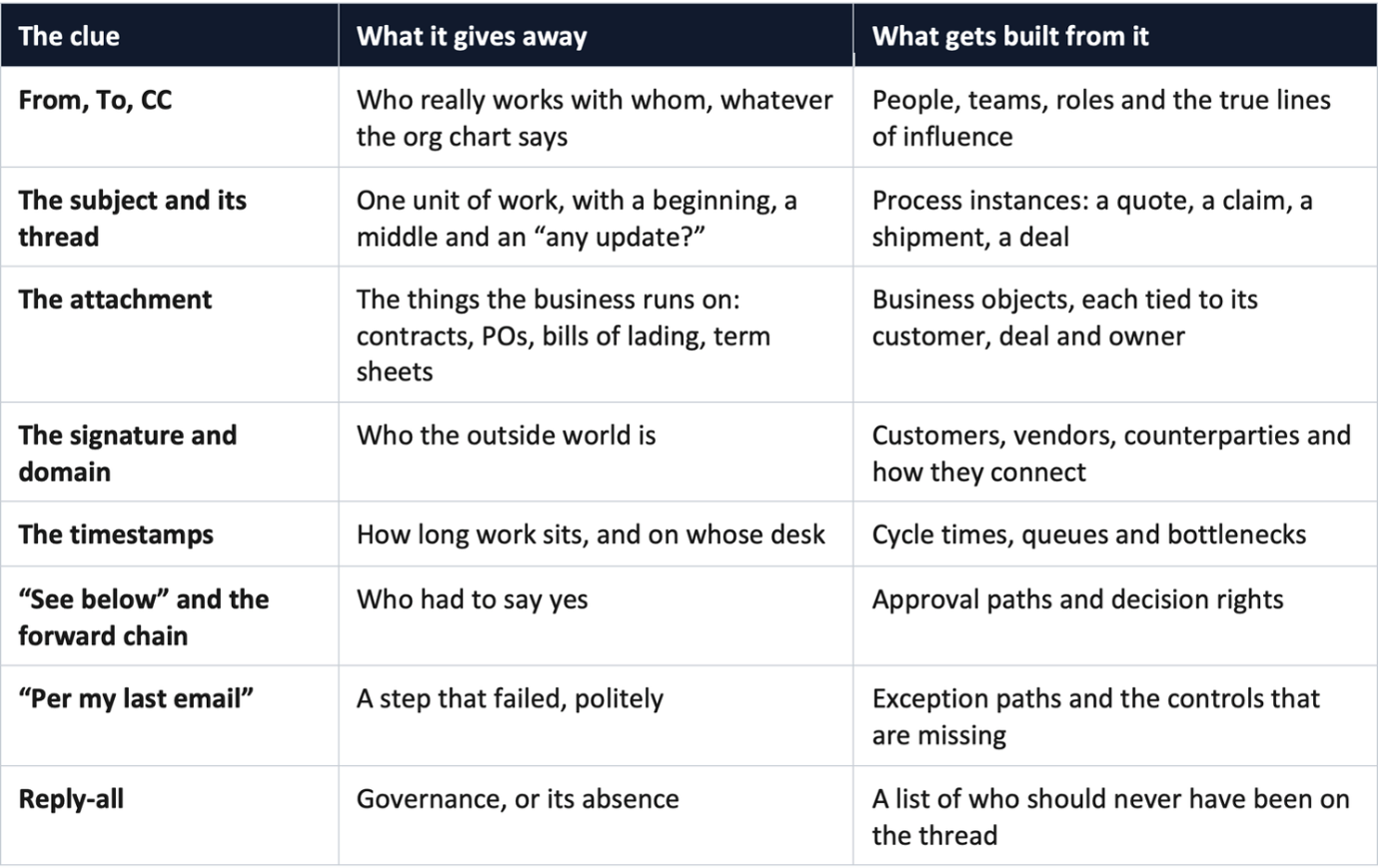
Put the clues together and you have an ontology: the company’s nouns and verbs, agreed once and written down. Customer, shipment, contract, approval. Who owns which, and what happens next.
Notice the order. The ontology was not a prerequisite for starting. It is what the first job left behind.
The ring also tells you which other systems to wire in. If half the threads contain a screenshot pasted from the order system, connect the order system. Add a few selected sources and the picture sharpens fast.
Out of that comes something no workshop ever produced: process maps that draw themselves and stay current. The hideous Visio diagram a consultant left behind in 2019 shows how the work was meant to flow. The inbox shows how it flowed on Tuesday.
One house rule holds from the old mailroom. The clerk delivers and does not gossip. Access is read-only, permissioned and logged, and the privileged envelope stays sealed.
The agent’s career path
The map is the education. What follows is a career, and it runs the same course Eddie’s did.
- Mail clerk. The agent connects to email and only reads. It sorts, tags and links, and drafts the first version of the ontology. It can break nothing, which is the entire point of a first job.
- Floater. It gets a badge for a few more systems: the CRM, the order book, the document store. Now it can compare what people said in email with what the systems of record say. The gaps are where the money is.
- Analyst. The process maps go live. It can show how a quote becomes an order, an invoice and, some days, a dispute, with the time and cost of every handoff.
- Advisor. Reasoning agents work across the map and rank what to automate, by value and by risk. They also notice what customers keep asking for that nobody sells. That is where new products and new business models come from.
- Department specialist. Agents trained in the trade take on real work, with a human signing off: freight documents, claims, trade operations, contract review.
- Chief of staff. The specialists coordinate across departments. The map has become a working model of the firm, where a change can be tested before anyone lives with it.
Each promotion is earned the way Eddie earned his: on the record of the job before it.
This is an inside-out roadmap. It starts with what the company already says to itself every day and works outward to what it could become. Nobody has to design the whole enterprise in advance. The plan gets built while the company does the work.
Meanwhile, back at the fund
Return to the trading firm that said no, and look at what flows through its inbox on an ordinary morning.
Dealer runs and axes. Broker confirmations. Allocations and settlement breaks. Redlines on trading agreements and side letters. Investor due-diligence questionnaires. Research notes. A compliance pre-clearance request, and the reply approving it.
An agent that has spent six months in that mailroom knows the counterparties, the instruments, the mandates and the limits. It knows who approves what, and how long they take. It has never touched a trade.
Its first wins are dull and they pay well. Breaks get resolved before lunch. The questionnaire drafts itself from the last forty answers. The research note someone wrote in March surfaces on the morning it finally matters.
Then the old question comes back around: are we ready for AI-assisted trading? It lands differently now. The firm’s vocabulary is written down. The guardrails have been tested on work that could not hurt anyone. Every action has a trail.
The partners are no longer debating a leap of faith. They are deciding on a promotion, with a file of evidence in front of them. They can still say no.
Who trains the new kid
No mail clerk ever climbed alone, and three things separate a rising agent from a stalled pilot.
Someone on the floor. Eddie had a supervisor who showed him which doors to knock on. The agent needs engineers who sit inside the business, next to the people doing the work, and build the ontology with them in weeks. A strategy deck delivered from a distance trains nobody.
Schooling in the trade. A generalist agent cannot tell a bill of lading from a bill of fare. Specialists that arrive already fluent in freight, or fixed income, or claims, start several rungs up the ladder.
A personnel file. The agent starts read-only. Every action is logged, every decision leaves a trail, and a person approves anything consequential. Governance usually gets cast as the brake on AI. Here it is the file the promotion committee reads, and the reason a promotion is possible at all.
And one condition from the owner’s side: the map belongs to the company. An ontology you cannot take with you is somebody else’s asset with your name on it.
The corner office
Keep promoting for a few years and something accumulates that nobody set out to buy: a digital twin of the company.
It was never commissioned. It was built one thread, one process and one department at a time, as a byproduct of useful work. It knows the firm’s people, objects, rules and rhythms, and it updates every time someone hits send.
At the top of that twin sits the last promotion: a shadow CEO. It runs the company in parallel, on the model. It sees every thread at once, forecasts the quarter, spots the account about to walk, and proposes the reorganization nobody dares to raise. Then it hands its recommendations to the human with the title.
Call the result a semi-autonomous organization. The agents carry the routine. The “semi” is where the board, the judgment and the accountability stay.
One system of work at a time
None of this has to be designed in advance. It is built one system of work at a time, on a roadmap the firm controls.
The mailroom comes first because it is the company’s nerve center, its original system of work and record. The first job there produces the foundation: the ontology, the firm’s own logic modeled once.
Then the systems of record are wired in, in order of value. Sales first, perhaps, with a person approving every decision that carries risk. Then operations. Then finance. Each goes live in weeks, governed and measured from its first day.
This is where the economics turn. The first job creates the ontology. The ontology makes the second job easier, and the second job adds context that makes the third more valuable. By the fifth function, most of what the agents need to know is already in place, so each new system of work arrives cheaper, faster and more capable than the last. That is why starting small does not mean thinking small.
Eventually work stops pausing at department walls. A deal becomes a contract, an invoice, an order and a delivery, and nobody retypes it along the way. Single jobs have become systems of work, and the systems of work have become a working model of the whole firm.
Autonomy widens on the same schedule, by earned trust and explicit decision rights. A person steps in wherever the firm has decided a person should.
That is how a semi-autonomous company gets built safely: in stages, to a plan, and never further ahead than the trust it has earned.
Start here
The way in is much smaller than a transformation program. Hire the mail clerk.
- Pick one job, not an enterprise. Choose a workflow that is rich in information, heavy with exceptions, crosses departments and can be measured. It should be harmless while the agent only reads. Leave the firm’s most consequential decision for later.
- Let the agent read before it acts. Connect it to the email around that workflow and one or two systems of record. Let it sort, link and learn. None of that requires authority.
- Build the map as you go. Turn what it finds into the firm’s vocabulary: people and roles, business objects, processes, decision rights, exceptions, controls. That is your ontology and your first system-of-work map.
- Measure the first job. Count hours saved, cycle time, exceptions resolved, errors avoided, revenue protected, work that used to vanish between departments. The goal of the first job is evidence.
- Promote the agent. Give it the next small responsibility. It reads, then shadows, then recommends, then acts with approval, then acts alone where the firm has explicitly said it may. Nobody skips a grade.
That list fits on a Monday-morning agenda, and it changes the question in the room. “How do we become an AI-native enterprise?” has kept many leadership teams talking for a year. “What is the first job we can give an agent?” can be answered before lunch.
Where it started
Someday a profile writer will ask the shadow CEO where it got its start, and the answer will be Eddie’s answer. It began at the bottom, with a cart and a floor plan, reading the outside of everybody’s mail.
So stop asking whether the company is ready for AI. Find the first job and give it to the mail clerk. Let the agent learn the firm from the inside out. Measure what it finds, promote it when it has earned it, and hand it the next job.
That is how the plan gets built, and how the company becomes ready.
Check the mailroom. There is an opening.